What is a Finite State Transducer?
In short, a finite state transducer (FST) can be used for analysis of text, but for the purposes of Indigenous Languages especially within our platform, we generally use them for “spell-checking” and to identify the “lemma” (dictionary form) of a word and its analysis.
Analysis example
Here we take the nêhiyaw (Plains Cree Y-dialect) word ê-ohci-kiskêyihtahk which could mean roughly “they (singular) know it”, and using the FST from the University of Alberta language team we might produce the following:
PV/e+PV/ohci+kiskêyihtam+V+TI+Cnj+3SgBesides the lemma this string (or ‘analysis’) gives us a bunch of tags as well:
- The “lemma” is
kiskêyihtam“s/he knows s.t., s/he knows s.t. of his/her own experience” , - Includes two “preverbs”,
PV/e+andPV/ohci+, - Word type is “verb”
+V, - Word class is “transitive inanimate”
+TI, - Word form is in the “conjunct mode”
+Cnj, - And finally, the subject is the third person, singular
+3Sg.
Why does this matter?
Indigenous languages can be complex, especially when it comes to understanding the grammar. In english, to understand the different ways you can use a word (for example “run”) depending on the subject we can evaluate the grammar like so:
1s: I run
2s: You run
3s: That one runs
3p: They run
1p: We run
21p: We run
2p: Y'all run
...
So in this example, we’ve only really run (pun intended) into two different variations or “conjugations” of the verb: run, and runs. If we kept going we would eventually get to run, runs, running, ran which may be the full extent of the conjugations for that verb in english.
For may Indigenous languages, however, there can be many different variations of a verb depending on who is being spoken about. Here is an example using the same verb run in nêhiyawêwin (Plains Cree Y-dialect):
1s: nipimipahtân
2s: kipimipahtân
3s: pimipahtâw
3p: pimipahtâwak
1p: nipimipahtânân
21p: kipimipahtânaw
2p: kipimipahtânâwâw
...
In this case we can see that there are different variations (conjugations) of the verb for every single form or change of subject. This gets even more complex when getting into transitive forms which really means involving a person and a thing (“you see it”) or two people (“you see her”).
Learning the grammar of an Indigenous language can be greatly beneficial, but also takes a lot of study. Having the ability to identify and study specific conjugations can help fast-track this process, especially if you can search for them.
This brings us to…
Language Database support
An added bonus we get when we have FST support for an Indigenous Language is that once we can identify the lemma of a word using the FST, we can group entries by the lemma within our Language Database. From here learners can search and browse to see and hear variations of any given word (or phrase) that’s been encountered in a transcription.
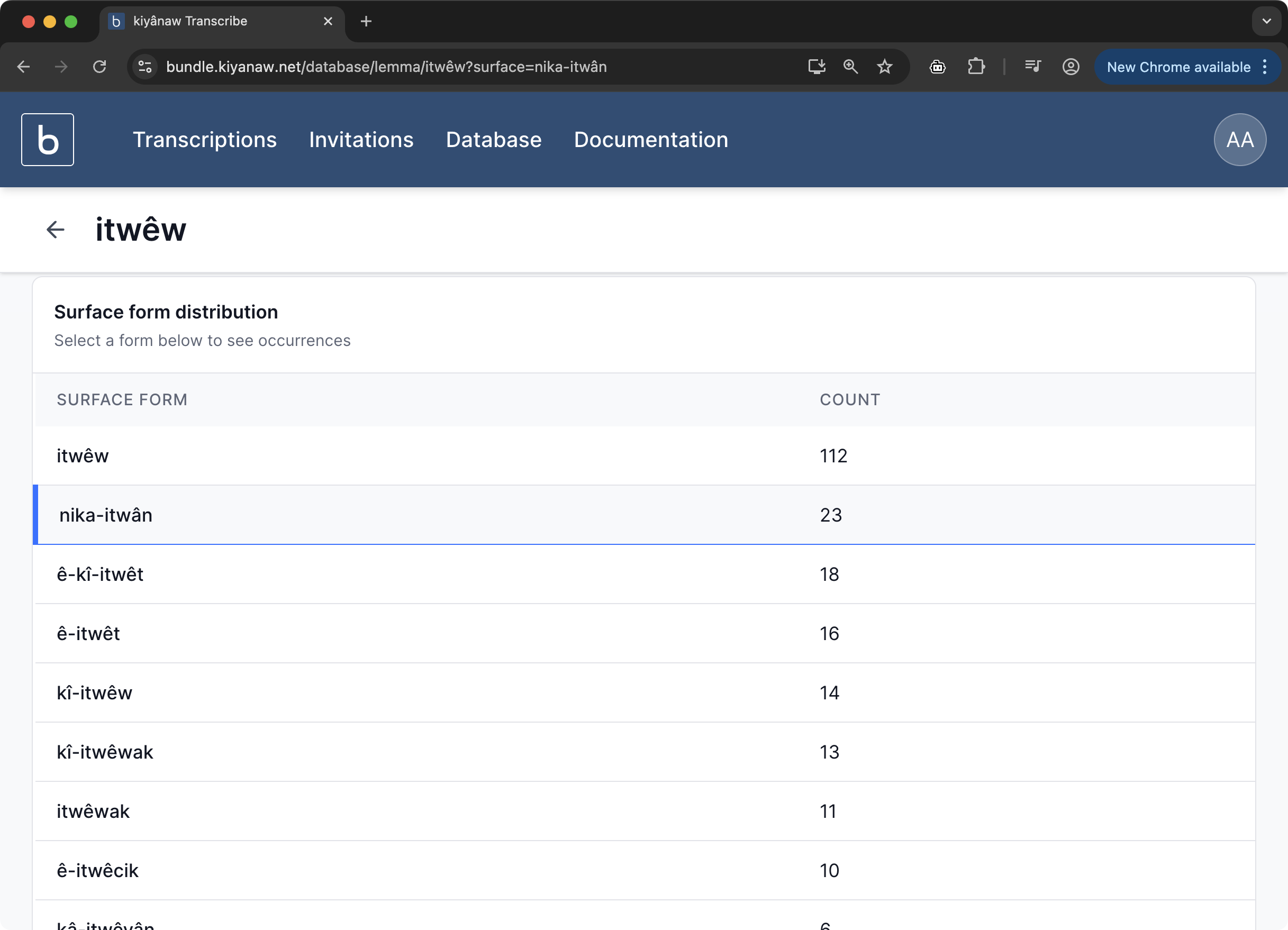
Here are some example conjugations of the nêhiyawêwin word itwêw “that one says”:
Encountered variations of itwêw
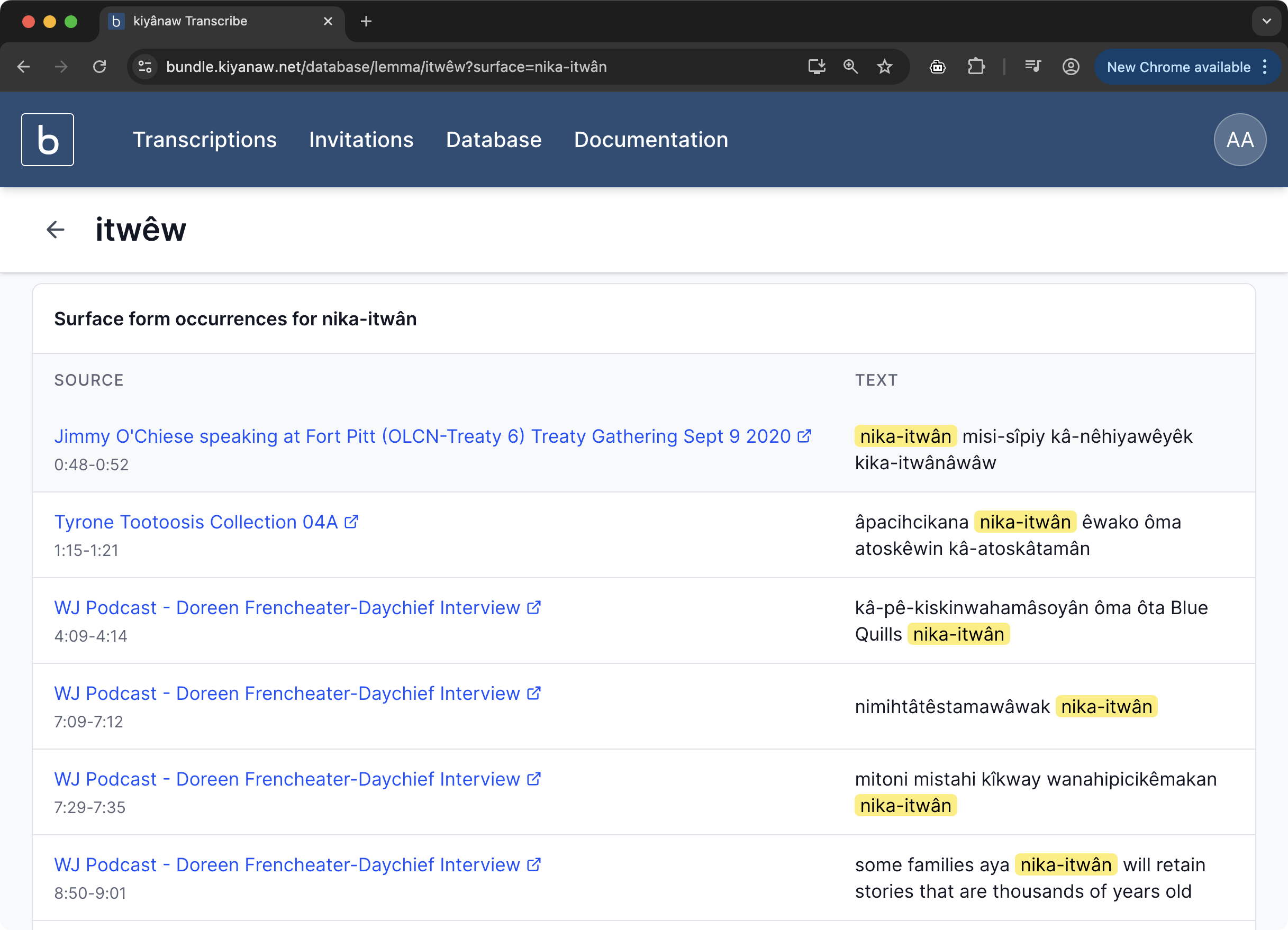
Attestations of variation nika-itwân
Find out more about Language Database here